APS-MCC: A320, B737 or Generic Simulator Which One to Choose?
Key takeaways:
- Generic: EASA-compliant, but doesn’t prepare you for real SOPs — not enough for airline assessments
- A320: the most relevant choice for most European airlines (easyJet, Transavia, Vueling, Air France, Volotea…)
- B737: makes sense if Ryanair is your main target
- A320 vs B737: two different philosophies, neither is easier than the other
- The real criterion: a type-representative simulator, not a generic one
Introduction :
You’ve decided to do an APS-MCC. Now you’re seeing offers on A320, others on B737, and some on “generic large jet simulators” — or even FFS. Prices vary wildly, and so do the sales pitches. And on forums, everyone has a different opinion.
Does it really matter? Yes. And more than you’d think.
APS-MCC: What EASA Regulations Say About the Simulator
The APS-MCC is governed by AMC2 FCL.735.A (EASA Decision ED 2017/022/R). The technical requirements for the simulator are specific:
| Criterion | EASA Requirement |
|---|---|
| Aircraft simulated | Multi-pilot, multi-engine, ≥50 passengers |
| Aerodynamics | Swept-wing jet |
| Visual system | ≥180° horizontal × 40° vertical |
| Systems | Representative of the aircraft class |
Source : AMC2 FCL.735.A, paragraphs (f) et (g)
A generic simulator can tick all these boxes. But EASA-compliant doesn’t mean useful for preparing an airline selection.
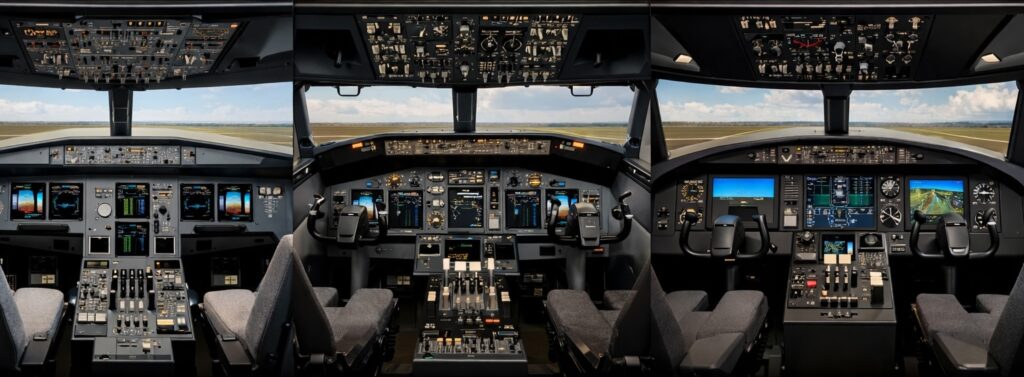
APS-MCC A320 B737 or Generic: What Really Changes
A320 Type-Representative
Cockpit faithful to Airbus logic:
- Sidestick, full fly-by-wire
- Flight protections (the aircraft rejects extreme inputs)
- Automatic trim
- ECAM for failure management
- FMGS (Flight Management and Guidance System)
Airbus philosophy: The aircraft protects the crew.
B737 Type-Representative
Cockpit faithful to Boeing logic:
- Yoke with force feedback
- Conventional controls (cables + hydraulics)
- Manual trim (“pickle switch” on the yoke)
- No flight protections in the Airbus sense
Boeing philosophy: The pilot decides, the aircraft executes.
Generic “Large Jet”
- Cockpit inspired by the A320 or B737, sometimes hybrid, without manufacturer data
- Simplified or hybrid systems
- Generic SOPs, rarely detailed, not manufacturer-specific
What you learn: Crew coordination (CRM, call-outs, PF/PM task sharing). But not the aircraft-specific logic.
| Criterion | A320 | B737 | Generic |
|---|---|---|---|
| Controls | Sidestick, FBW | Yoke, conventional | Variable |
| Trim | Automatic | Manual | Variable |
| Flight protections | Yes | No | No or simplified |
| SOPs | Airbus FCOM | Boeing FCOM | Generic |
| A320 selection prep | ✅ Direct | ⚠️ Requires adaptation | ❌ Insufficient |
| B737 selection prep | ⚠️ Requires adaptation | ✅ Direct | ❌ Insufficient |
| EASA-compliant | ✅ Yes | ✅ Yes | ✅ Yes |
| Average price | €5,000–6,500 | €5,000–6,500 | €3,500–4,500 |
Important: A320 and B737 represent two different philosophies, not a difference in difficulty. Neither is “more educational” than the other. Switching from one to the other requires adaptation — in both directions.
Why You Should Avoid a Generic Simulator for Your APS-MCC
Generic is cheaper. That’s its only advantage.
The problem: in airline assessments, you’ll almost always be evaluated on the type operated — A320 or B737. Sometimes on another aircraft from the same manufacturer (A330, B787…). Never on a hybrid cockpit with generic SOPs.
What you miss with an APS-MCC on a generic simulator:
The type-specific habits (call-outs, sequences)
The manufacturer logic (how the aircraft reacts, and why)
The reflexes that make the difference on the day
A candidate who completed their APS-MCC on a type-representative A320 arrives at an easyJet or Volotea assessment with 40 hours of practice using the right logic and the right SOPs. Someone who trained on a generic simulator starts from scratch.
How to Choose Between A320 and B737 for Your APS-MCC
Targeting a European airline → A320 in most cases. It’s the most operated aircraft in Europe: easyJet, Transavia, Vueling, WizzAir, Air France, Volotea, and many more.
Targeting Ryanair specifically → B737. Ryanair operates exclusively Boeing 737s and runs its selections on this type.
Not sure yet → A320. It’s the most operated family in Europe. The installed fleet is much larger than the B737, so there’s a higher chance your first selection will be on this type.
Doing your APS-MCC on one type and your selection is on the other? Don’t panic. It’s manageable, but expect around ten hours of preparation to learn the new logic.
What We Offer at Iroise
- APS-MCC on FNPT II MCC A320 type-representative:
- Cockpit aligned with Airbus logic (sidestick, FBW, ECAM, FMGS)
- 180° × 40° visual system compliant with AMC2 FCL.735.A
- TRI/TRE instructors currently active in airlines
- Why the A320? Because it’s the aircraft most of our trainees face in their first selection.
À lire aussi
- MCC or APS-MCC: Which Training to Choose in 2026?
- How to Choose Your ATO for APS-MCC: 5 Mistakes to Avoid
- The 9 EASA Competencies Assessed in Airline Selections
- Regulatory reference: Download the official document: AMC2 FCL.735.A — EASA Decision ED 2017/022/R