APS-MCC : How to prepare before your course
In brief
- The APS-MCC is an intensive course: ground school followed by 40 hours of simulator over 2-3 weeks. Arriving prepared changes everything.
- Three areas to focus on: Technical (aircraft systems, FMS, flows), ATPL revision (OPS procedures — minima, fuel, alternate selection, performance, weight & balance) and Human Factors (CRM, decision-making, human error).
- Reading documentation beforehand to get familiar: yes. Practising alone without having had any instruction: no.
- If your ATO provides CBT or e-learning, work through it seriously — it’s structured training content.
- Goal: arrive on day 1 with the logic understood so you can focus on what really matters — working as a crew.
Why preparing for your APS-MCC changes everything
The APS-MCC is not an observation course. It’s intensive training where every session counts.
Over 10 simulator sessions, you’ll need to learn a new aircraft, new procedures, a new way of working (PF/PM), and above all, learn to work as a crew. If you arrive discovering everything on day one, you’ll spend your first sessions catching up instead of developing your multi-crew skills.
Pilots who arrive prepared progress faster and finish the course at a significantly higher level. Those who wing it catch up — sometimes. But they miss out on part of the training’s value.
Aircraft systems: the big picture, not the details
The APS-MCC takes place on an airliner simulator — usually A320 or B737. But it’s not a mini type rating. The goal is not to know every system and failure procedure by heart.
EASA regulations (AMC FCL.735.A) are clear: the expected level of systems knowledge should be “sufficient for effective situational awareness during execution of procedures and checklists”. Nothing more.
What you need to understand in broad terms
- The aircraft’s various systems: which ones exist, how they work generally, what they’re for. Not the detail of valves, relays, or failure logic.
- How the autopilot and autothrust work: modes, general logic of arming and engagement.
- Operating limitations, configuration speeds, performance — all of this will be covered during the course.
How to work
If your ATO provides CBT or LMS content, work through it seriously. It’s content specifically created for your training.
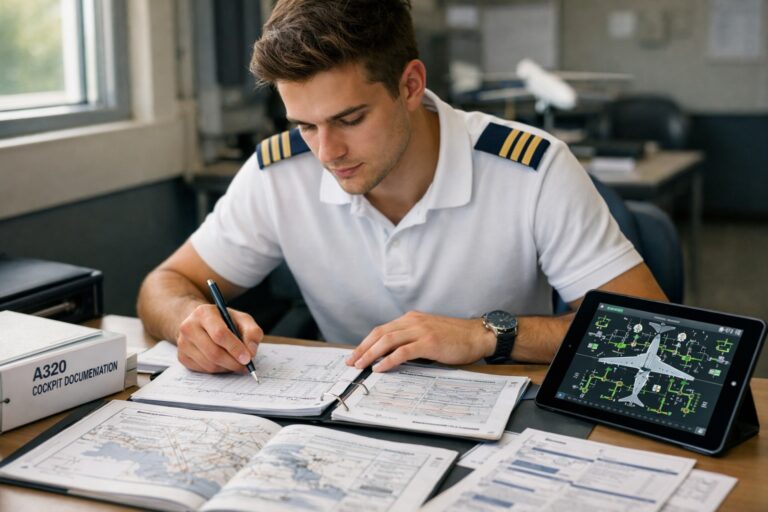
If your ATO only provides raw documentation (FCOM, system manuals), read it to familiarise yourself. Learn the document structure, start understanding how the aircraft works overall. But don’t force memorisation — that’s not what’s expected at this stage.
The goal: arrive with an overview. The detailed level will come during the course and later with your type rating.
ATPL revision: what will actually be useful
You’ve passed your 14 subjects. But let’s be honest: some of it is already hazy or forgotten. Certain subjects will directly apply in the APS-MCC.
- Human Factors — CRM, SHELL model, workload management, cognitive biases, communication, decision-making. This is the core of the APS-MCC.
- Operational Procedures — operating minima, fuel requirements, alternate accessibility and selection, approach chart reading. You’ll prepare and brief every flight using these.
- Operational Meteorology — reading METARs/TAFs, icing conditions, impact on minima. Weather preparation is part of every session.
- Performance and weight & balance — general principles. Detailed calculations will be covered in training.
SOPs, flows and FMS: understand first, practise later
This is where the difference shows between a prepared trainee and one who struggles. But be careful: preparing doesn’t mean training alone without a framework.
Understanding PF/PM logic
In initial training, you did everything yourself: decide, execute, verify. In multi-crew, the roles are separated.
The Pilot Flying (PF) manages the flight path: they fly, decide on configurations, give the commands. The Pilot Monitoring (PM) handles everything else: radio, checklists, FMS programming, and above all, monitoring the PF.
You’ll alternate between both roles on every flight. You need to understand both.
Flows and checklists
On light aircraft, you typically use a do-list: you read each item and execute it. On airliners, it’s different: you first execute a “flow” (a memorised sequence of actions), then verify with a checklist.
Example: before takeoff, the PM executes the “before takeoff” flow (strobes, AP modes armed, transponder, etc.), then calls the checklist to confirm everything is done.
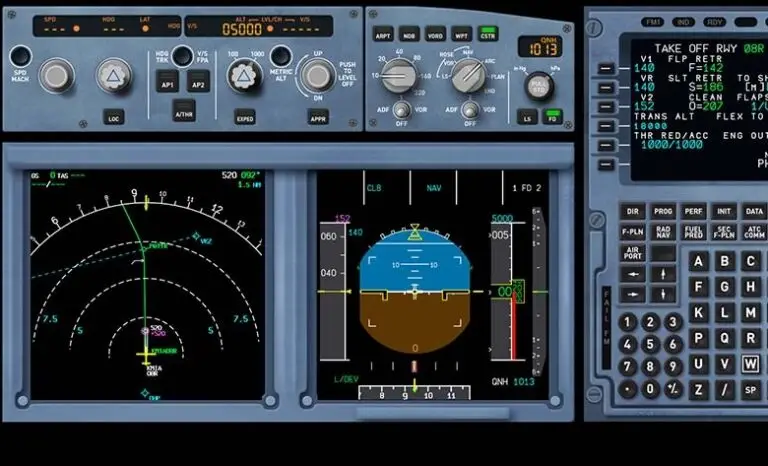
Same logic for the FMS/MCDU: you need to understand what it’s for, what the main pages are, what order data is entered. Not memorise a sequence of keystrokes.
The trap of unguided preparation
You often read this advice: “Buy a cockpit poster and practise your flows at home.” Or: “Watch YouTube tutorials on the MCDU and practise on a trainer.” It’s tempting, and it’s not useless — but you need to know how far to go.
Getting familiar with these resources, having a first look at what it’s like, understanding the general logic: yes. Going all in, memorising sequences, practising intensively: no.
Why? Because without having had instruction, you risk misunderstanding or learning incorrect things. Tutorials are often based on consumer simulators that aren’t perfectly accurate to the real type. Your ATO’s simulator may also have its own particularities. If you memorise sequences without understanding the logic, you embed errors that will need correcting later. And unlearning is harder than learning.
The exception: if your ATO provides training material — online courses, SOP guides, dedicated MCDU trainer — then yes, use it fully. It’s designed for their course, validated by their instructors, consistent with what you’ll see in the simulator. There, you can practise safely. Otherwise, stick to familiarisation, not memorisation.
The question of perspective
In theory, some external resources can be excellent — a tutorial made by an experienced TRI, for example. But in practice, how do you know? A trainee who hasn’t yet done the course doesn’t have the perspective to judge whether a resource is reliable or not. You don’t yet know what you don’t know.
That’s why the prudent rule is simple: trust what your ATO provides — it’s their responsibility to give you content suited to their programme and their simulator. External resources, use them to familiarise yourself, not to train.
What this means in practice
If your ATO provides e-learning or CBT explaining SOPs, flows and FMS, work through them seriously. That’s the foundation. Once you’ve understood the logic through this structured framework, you can practise with the tools provided (mock-up, VPT, poster, FMS trainer).
If your ATO only provides raw documentation, read it to familiarise yourself. Learn the structure, understand the general logic. But don’t force practice until you’ve had instruction.
If your ATO provides nothing and tells you to “figure it out”, that’s a red flag.
CRM in practice
In the sim, CRM means: verbalising what you’re doing, listening to your partner, saying “I disagree” when necessary, accepting correction without getting defensive. If you’re used to flying solo, the transition to crew can be unsettling. Prepare yourself mentally.
The right mindset
The APS-MCC isn’t just an exam to pass. It’s training to experience. Mistakes are part of the process.
Arrive with the intention to learn, not to prove yourself. The pilots who progress fastest are those who listen, adapt, and genuinely work as a team.
Sim partner and logistics
Working with your sim partner
You’ll spend 10 sessions with the same person. If you know them beforehand, suggest working together: review the documentation, discuss unclear points. Even a few hours of joint preparation changes the dynamic. If you don’t know them yet, exchange messages as soon as you make contact about your levels and areas of discomfort.
Arriving in the right condition
The APS-MCC is demanding: 2-3 intensive weeks. Arrange accommodation close to the centre, clear your other commitments, prepare your administrative documents.
During the course: sleep enough, eat properly, avoid late nights. This is the time to learn, not to test your resistance to fatigue.
Key takeaways
Preparing before the APS-MCC is essential. But preparing intelligently is different from “figuring it out alone”.
Read the documentation to familiarise yourself. Work through the CBT if your ATO provides it. Revise the useful ATPL subjects. Prepare your CRM mindset. External resources can help you get an initial view — but without the perspective to judge their reliability, stay cautious: familiarise yourself, don’t train on them.
And choose an ATO that gives you a real training framework — not just files and goodwill.
Related article: APS-MCC: what a typical training day looks like
What we offer at Iroise Aero Formation
At Iroise, we believe preparation is part of the training.
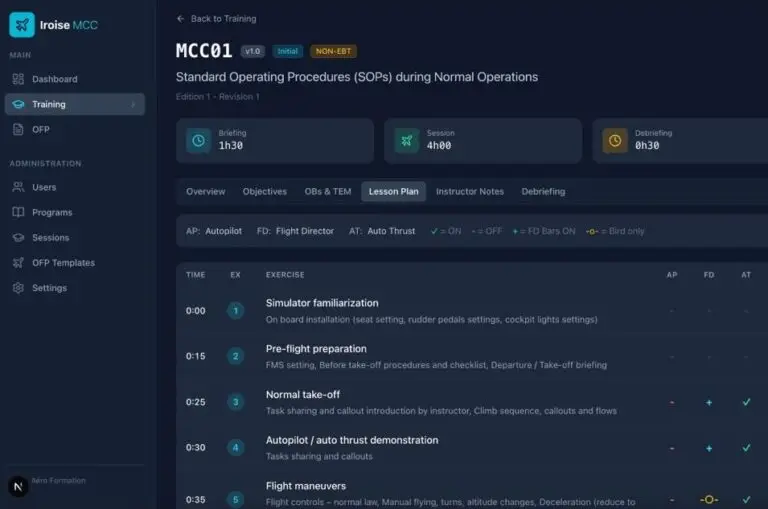
- LMS with dedicated courses to complete before arrival: A320 systems modules (5h), CRM (5h), SOPs, dedicated preparation courses — real courses with integrated assessments, not raw documentation. You understand the logic before you arrive.
- Briefings that consolidate e-learning: What you worked on alone is reviewed with the instructor. We check your understanding, correct any misinterpretations before moving to practice.
- Tools provided: Cockpit poster, FMGC trainer, VPT. Once you’ve understood through the courses, you can practise with the right tools.
The goal: that you arrive prepared with the right foundations, progress quickly, and finish the course at a level that makes you genuinely employable.